
Cook and Learn: Menu in English for Kids, Simple Recipes, and Shared Moments
Welcome to a practical and thorough guide to integrating cooking into language learning: a proposal designed for families and educators who want to turn mealtime into an educational, fun, and effective experience. Here you will find ideas, menus, simple recipes, and strategies to create shared moments that reinforce vocabulary, pronunciation, and confidence in English through play and daily practice.
- Learn English fast and easy
- Your first course for free
- Start now
Why combine cooking and learning at home?
Learning a language is more effective when it is associated with multisensory experiences. Cooking offers smell, taste, sight, and touch; moreover, it is a collaborative activity that facilitates natural repetition and recall. If your goal is a menu in English for kids or simple recipes in English for kids, cooking is a powerful tool: it turns vocabulary into action and converts grammar into understandable and memorable instructions.
Weekly plan: menu in English to practice every day
This is an example of a simple plan that you can adapt. Each day has a short recipe and clear linguistic objectives: thematic vocabulary, functional phrases, and a reinforcement activity.
- Monday — Interactive breakfast: ingredient vocabulary (eggs, milk, bread) and simple expressions to ask and offer.
- Tuesday — Healthy snack: fruit bodies (apple, banana), adjectives (sweet, sour), and short questions.
- Wednesday — Easy main dish: cooking verbs (mix, chop, bake) and imperative structures (Cut the tomato. — Cut the tomato.).
- Thursday — Simple dessert: quantities and comparatives (more, less), and taste phrases (I like it. — I like it.).
- Friday — Themed menu: create a small restaurant at home to practice dialogues.
Each recipe is accompanied by questions, mini-games, and a playful mini-evaluation that allows progress measurement without pressure.
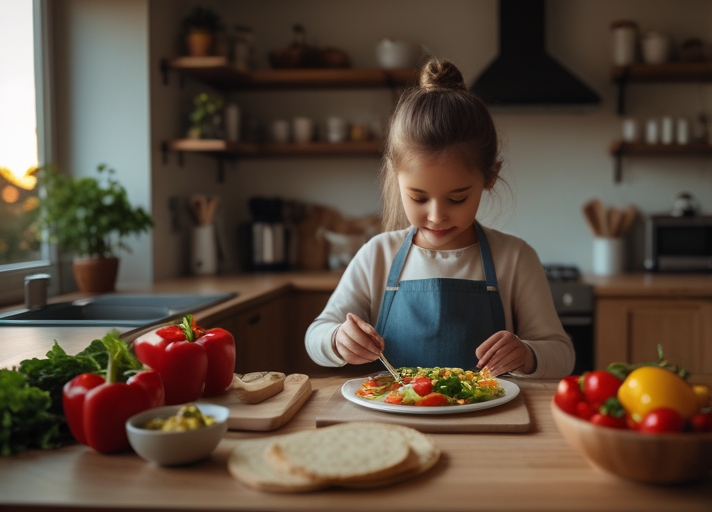
Practical example: easy French toast
Linguistic objective: learn bread, egg, milk, butter and practice imperatives and preference phrases.
- Ingredients: 2 eggs (2 huevos), 1 cup of milk (1 taza de leche), 4 slices of bread (4 rebanadas de pan), butter (mantequilla).
- Instructions in English and Spanish:
- Beat the eggs and milk. — Bate los huevos y la leche.
- Dip the bread in the mixture. — Introduce el pan en la mezcla.
- Fry with butter until golden. — Fríe con mantequilla hasta que esté dorado.
- Activation: ask the children to name the ingredients before starting and to repeat the instructions out loud.
This format combines oral practice, comprehension, and action; it also offers opportunities for affective correction and positive reinforcement.
How to design simple recipes that really work
A useful recipe for learning meets three requirements: brevity, repetition, and emotion. If you are looking for menu in English for kids or simple recipes in English for kids, design steps that repeat every week and allow the family to use key words again and again in different contexts.
Practical rules to create educational recipes
- Keep under six steps: children's working memory (and that of busy adults) works better with brief instructions.
- Repeat structures: use the same commands (Cut, Mix, Serve) so language becomes automatic.
- Include roles: assign tasks with phrases in English — for example, "You are the chef" — to reinforce identity and motivation.
- Connect with emotions: celebrate when something goes well to associate English with positive experiences.
Applying these principles, every meal turns into an active and emotional lesson.
Complementary activities to reinforce vocabulary
Besides cooking, you can enhance learning with small games and routines that increase exposure and repetition:
1. Visual labels
Create labels for ingredients and utensils with the word in English and an image. Ask children to place the correct label during the recipe. This technique is simple and produces an immediate visual memory effect.
2. Mini table dialogues
Before eating, establish a routine: a question in English that everyone answers (for example: "What did you help with today?" — ¿Con qué ayudaste hoy?). These micro-interactions generate real communicative practice.
3. Role play: restaurant at home
Organize a session where children are waiters and adults are customers. Use simple menus in English and functional phrases: "Can I have…?", "How much is…?" and their translations. This boosts fluency and improvisation skills.
Menu ideas by age
Needs and attention vary with age; below you have menus designed for different age ranges:
Ages 2-4 years
- Snacks: fruit sticks, plain yogurt.
- Focus: basic vocabulary (colors, fruits) and short phrases (I want, I like).
Ages 5-8 years
- Simple dishes: sandwiches, pancakes.
- Focus: action verbs and imperative structures (Spread, Flip).
Ages 9-12 years
- Recipes with multiple steps: wraps, simple pasta.
- Focus: sequences and more specific vocabulary (ingredients, utensils), as well as small measuring tasks.
Measure progress without stress: simple tools
Evaluation doesn't have to be formal. Watch five simple indicators:
- Spontaneous repetition: when the child says words in English without being asked.
- Understanding instructions: if they successfully follow commands in English.
- Social interaction: if they use phrases to ask or thank.
- Recognizable pronunciation: improvements in difficult sounds.
- Attitude and confidence: less fear of making mistakes.
Briefly note (one line) after each session; over time you'll see real improvement trends.
Quick activities for each indicator
- Memory cards: 5 minutes for the child to name 5 ingredients in English.
- Mini-competitions: prepare something in less time and describe it (social proof and healthy urgency).
Addressing common challenges
Family practice entails obstacles: lack of time, child resistance, caregiver coordination mismatch. Here are applied solutions:
Lack of time
Plan a quick recipe once a week and use leftovers for the next day's vocabulary. Even 10 minutes of daily exposure makes a difference.
Lack of participation
Connect the activity to a child's interest (favorite character, small reward). Use the principle of social proof: if other children in the family participate, motivation grows.
Doubts about correction
Correct with empathy: reformulate the correct phrase and have the child repeat it. Avoid overcorrection that can cause anxiety.
A personalized example: the story of Clara and Tomás
Clara is mother to Tomás, 7 years old. They started with simple recipes: toast, fruits, and smoothies. Clara named each ingredient in English and asked Tomás to help with short tasks. In two months, Tomás responded spontaneously in English when asked what he had cooked at school. That small change—the ability to speak fearlessly—came from short, repeated, and motivating routines.
Clara's experience shows that the combination of emotion, repetition, and a safe environment generates sustainable improvements.
Step-by-step simple recipes (expanded list)
Here you have a practical selection of recipes designed to involve children and reinforce vocabulary. Each recipe includes model phrases in English and their translation.
1. Simple chicken wrap
Ingredients: tortilla, cooked chicken, lettuce, tomato, cheese.
Useful phrases: "Put the chicken on the tortilla." — Pon el pollo en la tortilla. "Roll it up." — Enróllelo.
2. Fruit smoothie
Ingredients: banana, milk, yogurt, honey.
Useful phrases: "Add the banana." — Añade el plátano. "Blend until smooth." — Mezcla hasta que esté suave.
3. Mini bread pizzas
Ingredients: slices of bread, tomato sauce, cheese, toppings.
Useful phrases: "Spread the sauce." — Unta la salsa. "Sprinkle cheese." — Espolvorea queso.
Final tips to sustain the habit
The key is consistency and emotion. Keep the experience positive, record small achievements, and share victories with the family. If you integrate simple menus and related activities, you will see real progress and a greater willingness to use the language outside the kitchen.
If you want to deepen and access structured resources that complement these ideas with exercises and lessons, I invite you to explore an additional practical guide for introductions and communication that fits your goals: student personal introduction in English example. This internal reference will give you model phrases and activities to combine with cooking sessions.
To start today:
- Choose a short recipe. Make it together and repeat key phrases in English.
- Record a line of progress. What did the child say today in English that they didn't say a month ago?
- Turn practice into a game. A small role or virtual badge keeps motivation high.
With patience, creativity, and short routines you will transform meals into learning moments. Apply these ideas, adapt the menus, and watch how the language becomes a natural part of family life. Enjoy cooking and learning together!